


.jpg)

The Altitude Advantage
Why brands that advertise on the Alps
perform better long after the season ends.
BY ALPDEST RESEARCH & STRATEGY SPRING 2026

There is a moment, somewhere between the gondola doors closing and the first glimpse of the valley below, when something shifts. The phone goes into the pocket. The shoulders drop. The mind, which has been running at city speed for months, begins — finally — to slow down.
This is the state your audience is in when they see your campaign on the mountain. And it changes everything.
AT A GLANCE
4-6x
Longer avg. dwell time vs. comparable urban formats
€95k+
Average household income of European Alpine skiers
45+
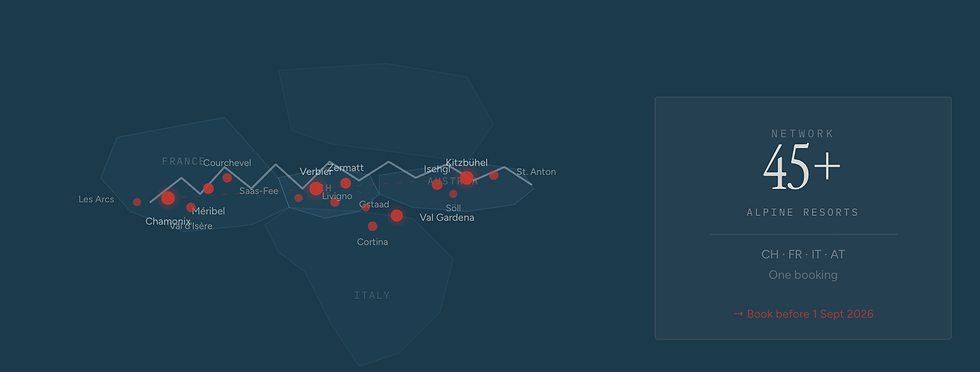
Top Ski Resorts across the Alpdest European network
01
The problem with most outdoor advertising is attention.
Urban OOH performs in one of the most saturated cognitive environments there is. High reach, constant exposure—but also constant competition. Commuters in motion. Screens layered across sightlines. Mental bandwidth already allocated to logistics, deadlines, and decisions. A campaign in this context is seen, but it shares space with everything else: a delayed train, an unread email, the next meeting. The impression lands, but it rarely lingers.
Alpine advertising operates in the opposite conditions.
A skier on a mountain is, by almost every measure, a different kind of audience. They are on holiday. They have chosen to be there. They are physically active, emotionally elevated, and — crucially — present in a way that urban life rarely allows. There are no notifications. No traffic. No competing screens. The environment itself commands attention, and anything placed within it benefits from that command.
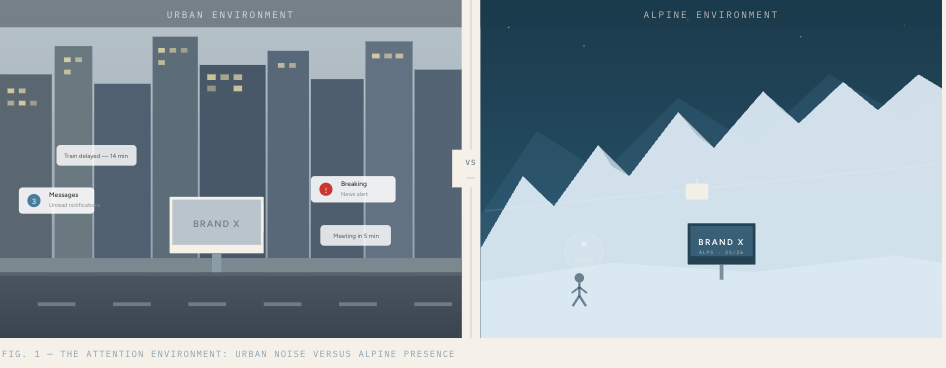
"The environment itself commands attention,
and anything placed within it benefits from that command."
02
Dwell time is the metric nobody talks about enough.
In traditional OOH planning, reach and frequency dominate the conversation.
How many people see the format? How often? These are useful numbers, but they say nothing about the quality of the encounter.
At Alpine placements — gondola stations, base lodge approaches, slope-side megaboards — average dwell times run between four and six times longer than comparable urban formats. A skier waiting for the lift is not moving. They are standing, looking, taking in their surroundings.
More significantly, the encounter happens in a context of anticipation and pleasure. The brain, in a state of leisure and mild physical exhilaration, is more open to new information, more likely to form associations, and more inclined to remember what it sees. Neuroscience has a term for this: elevated affect encoding.
In plain language: memories formed in positive emotional states stick harder.
Your campaign, seen on a powder morning at 2,000 metres, is encoded differently than the same campaign on a billboard outside a supermarket. It attaches itself to the experience. It travels home with the audience.
03
The audience is not just captive. It is exceptional.
Across the 45+ European resorts in the Alpdest network, the average household income of visiting skiers exceeds €95k+. These are not passive consumers — they are active decision-makers with significant purchasing power, a preference for quality over price, and a demonstrated willingness to invest in premium products and experiences.
This is an audience that buys watches, not just tells the time. Books hotels, not just finds somewhere to sleep. Chooses a brand because it aligns with how they see themselves — and the mountain, it turns out, says a great deal about how they see themselves.
For luxury and lifestyle brands in particular, the alignment is structural. The ski resort is already a curated environment. Premium hospitality, world-class sport, a shared culture of excellence and adventure. A campaign placed within that environment inherits its values by proximity. The mountain doesn't just display your brand — it contextualises it.
04
The halo effect is real, and it follows people home.
Post-trip research consistently shows elevated brand recall among Alpine holidaymakers compared to control groups exposed to the same campaigns in urban environments. More interestingly, purchase intent scores rise not just during the trip but in the weeks following it — a pattern that suggests the emotional associations formed at altitude persist into everyday consumer behaviour.
This is the halo effect in practice. The warmth of the holiday extends, briefly but meaningfully, to the brands encountered during it. A watch seen in Verbier carries a trace of Verbier. A car brand positioned at the base of a Dolomites descent carries something of that descent.
It is, in the end, about the company a brand keeps. And at altitude, the company is exceptional.
05
What this means for media planning.
Alpine OOH is not a niche tactic or a seasonal add-on. For brands targeting affluent, experience-led audiences, it is one of the highest-quality impressions available in the European market. The reach is focused rather than broad but the depth of that reach, the quality of the encounter, and the durability of the memory make it a fundamentally different category of investment.
The question is not whether Alpine advertising works. The data is unambiguous on that. The question is where, when, and with whom — which placements, which resorts, which moments in the season offer the greatest return.
That is a conversation worth having before the first snow falls.


Kommentare